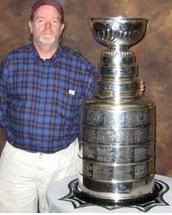
I went to the Oklahoma Aquarium (located in Jenks, Oklahoma) yesterday. I'm happy with the photos I took, but was a bit rushed. I was there while waiting on repairs on my truck. While waiting on the repairs, I walked around town and ended up at the aquarium.
Created with Admarket's flickrSLiDR.
Saturday, February 14, 2009

Sunday, January 11, 2009
The Colonoscopy
It's a subject that feels very private, embarassing to talk about, and so you don't read much about the subject, except for the medical definitions; the colonoscopy. I reached the age (and passed it a little) of when they recommend that all men start getting this procedure. I'd heard about it years earlier and so I was not looking forward to this. I wont say I was scared, but I wasn't looking forward to it; and the fact that I couldn't find anything from someone that had it, I was convinced that it was going to be a horrible experience.
To put it in laymen's terms, they run a tiny video camera up your butt so that they can check for any signs of cancer or things that are pre-cancerous. Is that embarassing and graphic enough of a description?
It's no wonder that no one wants to talk about this. They just want to get it over. And of course, that is what causes the "fear of the unknown". I was convinced that this would be a horrible experience.
Rather than to go into much detail, I just say that the procedure was pretty much nothing. You wont remember it. They give you 2 drugs; one for pain and the other that causes amnesia. What I remember is laying down on a table, seeing the doctor for about 10 seconds, turning around to get comfortable; and the next I remember is being dressed already and my wife asking me if I was ready to leave.
There never was any pain. The most pain I had was in getting the IV in my arm. It was so cold that day and so the nurse had a difficult time finding a vein in my hand, and because the preparations for the procedure require no drinking from midnight on that day, I was a bit dehydrated, which makes finding a vein difficult. So they had to do it in my arm. I hate needles anyway, so this was not fun. It was necessary and I kept thinking that if this is the worst of it, then I'm okay. It's better than having cancer.
I can honestly say that the worst part of the whole thing is actually done the day before. At noon the previous day, I had to start drinking this stuff they gave me for starting the colon cleansing. It was a cherry flavored drink, but as far as I was concerned, it was like drinking cherry flavored power steering fluid.
After drinking that mess, I mixed up a drink they wanted me to have at 18:00. They recommended that I drink it cold (because it tastes better, they said), so I mixed it up earlier and had it in the refrigerator. At 18:00, I started drinking that stuff. I had to drink 8 ounces of the stuff every 15 to 30 minutes (4 drinks of 8 ounces each).
I can tell you this drink was nasty. It tasted like it had already been through me once.
Nasty!!!!
And then at 21:00, I had to drink another bunch of this stuff, 8 ounces every 15 to 30 minutes, 4 times. So I had 32 ounces that I had to drink at 21:00, and another 32 ounces that I started at 18:00.
This stuff was nasty. I could barely get it down. However, this was the most effective laxative I've ever seen. It worked. By 23:00, I was pretty well cleaned out. I drank lots of water. During that time, could only have clear liquids, so I was careful about what I could drink, but had no food from about noon on.
And then after midnight, I had no food or water until the procedure. That's where I messed up on scheduling. I should've scheduled the procedure at 8:00 or earlier, because then I wouldn't have been in such agony all day wanting to eat or drink. My procedure wasn't until 13:30.
My recommendation is to schedule a colonoscopy for early Monday morning, that way the preparation stuff can be done on Sunday and not require two days off work.
Oh. I forgot to mention the fun part (if you can call it that). They pump you full of CO2 so that they can get the camera in easily and see inside. However, afterwards, they have to make sure the gas is out before they send you home, so while you're still recovering they take you to "the fart room". I'm told the farts are award winning as far as volume and length, but because of the drugs, I barely remember one time. I wish I'd had a recording device though, because it was a good one.
Now, this story wouldn't be complete without mentioning that after this whole thing was over, it wasn't so bad. The worst part was the preparation, not the procedure itself. And the good thing for most everyone else, is that afterwards I found out that there is an alternative to the junk I had to drink. They have pills!!!!
Are you kidding me?
That doctor knew this was available and made me drink that nasty stuff?
Never again!! It's the pills for me next time. And if there is ever a way I can force some of this nasty bile down that doctor's throat, I plan on doing so. I was so angry when I found out that there was an alternative to the torture that I went through having to drink that nasty stuff.
Anyway, I got a "clean" bill of health. They found nothing even remotely suspicious so I wont have to have another colonoscopy for a few years, and I do plan on insisting on the pills rather than the drink.
I hope I haven't left out any important aspects of this, but mostly I just wanted to get across to anyone that will have to go through the procedure for their first time, that it really is nothing to worry about. The laxative and not being able to eat was the worst part of it. Better scheduling, and the pills instead of the drink, would make this whole thing a better experience.
And of course, having the colonoscopy for early detection is a smart thing to do.
To put it in laymen's terms, they run a tiny video camera up your butt so that they can check for any signs of cancer or things that are pre-cancerous. Is that embarassing and graphic enough of a description?
It's no wonder that no one wants to talk about this. They just want to get it over. And of course, that is what causes the "fear of the unknown". I was convinced that this would be a horrible experience.
Rather than to go into much detail, I just say that the procedure was pretty much nothing. You wont remember it. They give you 2 drugs; one for pain and the other that causes amnesia. What I remember is laying down on a table, seeing the doctor for about 10 seconds, turning around to get comfortable; and the next I remember is being dressed already and my wife asking me if I was ready to leave.
There never was any pain. The most pain I had was in getting the IV in my arm. It was so cold that day and so the nurse had a difficult time finding a vein in my hand, and because the preparations for the procedure require no drinking from midnight on that day, I was a bit dehydrated, which makes finding a vein difficult. So they had to do it in my arm. I hate needles anyway, so this was not fun. It was necessary and I kept thinking that if this is the worst of it, then I'm okay. It's better than having cancer.
I can honestly say that the worst part of the whole thing is actually done the day before. At noon the previous day, I had to start drinking this stuff they gave me for starting the colon cleansing. It was a cherry flavored drink, but as far as I was concerned, it was like drinking cherry flavored power steering fluid.
After drinking that mess, I mixed up a drink they wanted me to have at 18:00. They recommended that I drink it cold (because it tastes better, they said), so I mixed it up earlier and had it in the refrigerator. At 18:00, I started drinking that stuff. I had to drink 8 ounces of the stuff every 15 to 30 minutes (4 drinks of 8 ounces each).
I can tell you this drink was nasty. It tasted like it had already been through me once.
Nasty!!!!
And then at 21:00, I had to drink another bunch of this stuff, 8 ounces every 15 to 30 minutes, 4 times. So I had 32 ounces that I had to drink at 21:00, and another 32 ounces that I started at 18:00.
This stuff was nasty. I could barely get it down. However, this was the most effective laxative I've ever seen. It worked. By 23:00, I was pretty well cleaned out. I drank lots of water. During that time, could only have clear liquids, so I was careful about what I could drink, but had no food from about noon on.
And then after midnight, I had no food or water until the procedure. That's where I messed up on scheduling. I should've scheduled the procedure at 8:00 or earlier, because then I wouldn't have been in such agony all day wanting to eat or drink. My procedure wasn't until 13:30.
My recommendation is to schedule a colonoscopy for early Monday morning, that way the preparation stuff can be done on Sunday and not require two days off work.
Oh. I forgot to mention the fun part (if you can call it that). They pump you full of CO2 so that they can get the camera in easily and see inside. However, afterwards, they have to make sure the gas is out before they send you home, so while you're still recovering they take you to "the fart room". I'm told the farts are award winning as far as volume and length, but because of the drugs, I barely remember one time. I wish I'd had a recording device though, because it was a good one.
Now, this story wouldn't be complete without mentioning that after this whole thing was over, it wasn't so bad. The worst part was the preparation, not the procedure itself. And the good thing for most everyone else, is that afterwards I found out that there is an alternative to the junk I had to drink. They have pills!!!!
Are you kidding me?
That doctor knew this was available and made me drink that nasty stuff?
Never again!! It's the pills for me next time. And if there is ever a way I can force some of this nasty bile down that doctor's throat, I plan on doing so. I was so angry when I found out that there was an alternative to the torture that I went through having to drink that nasty stuff.
Anyway, I got a "clean" bill of health. They found nothing even remotely suspicious so I wont have to have another colonoscopy for a few years, and I do plan on insisting on the pills rather than the drink.
I hope I haven't left out any important aspects of this, but mostly I just wanted to get across to anyone that will have to go through the procedure for their first time, that it really is nothing to worry about. The laxative and not being able to eat was the worst part of it. Better scheduling, and the pills instead of the drink, would make this whole thing a better experience.
And of course, having the colonoscopy for early detection is a smart thing to do.
Friday, December 19, 2008
The Illusion
A few years ago, I worked for a company that appeared to be a real financial opportunity. Everyone thought so. However, I looked at the overhead costs and never felt that way. I felt uneasy about it and often made suggestions for projects that would increase efficiency and lower this overhead. Management always rejected these ideas, feeling that they were unnecessary. When I explained that we were operating at a loss; that it costed us more to offer our services to customers than the market would be willing to pay for, their resposne was "we'll make it up in volume".
Make it up in volume?
Are you kidding me?
All that means is that we go deeper and deeper into debt and only appear to be doing well. They, like many companies, could do some creative accounting and put things on the books so that it would appear that with our ever increasing revenues, that the company was strong and had a great future.
They made it look as if even though we weren't profitable, that with increased revenues, we soon would be. And of course, it was all an illusion.
That company, in the wake of the realities revealed with Enron, soon went Chapter 11, just as Enron did. Hundreds of thousands of 401(k) plans took the brunt of the losses. It was a horrible thing. It was a preventable thing.
All that said, this is the same thing that we are doing with our economy. And the saddest part is, the people in charge, Democrat and Republican alike, have no clue that they are going down the same paths. In fact, they plan on using trillions of your dollars to make the problem worse. Essentially, they hope to "make it up in volume".
Cutting past the shell game that they've turned this all into, the fact is, it all boils down to spending more than you bring in. All roads regarding this economic disaster lead back to spending more than you make.
Sub-prime mortgages; bottom line is that people were buying homes that couldn't afford them. As long as we were "making it up in volume", in essence, keeping the collective spending going, the illusion kept everyone happy and things could continue on. Underneath though, the fact is that it was an illusion and the money wasn't there. The value in the economy wasn't there. It was a myth.
And contrary to just blaming all the Wall Street guys, the fact is that these bad loans were packaged and sold as mortgage backed securities. Those securities were bought in good faith on Wall Street, as they were valued according to rules that Congress set up. Congress allowe these worthless pieces of paper to be valued as if the mortgages were those of people able to actually make the payments. Those worthless pieces of paper made victims of a lot of Wall Street guys too. They bought paper that everyone should've known they were bad, yet they were valued according to "the rules".
People say that regulation would've fixed this problem, but they're wrong. It might've fixed some of the problem, but the fact is that regulations existed, but just didn't apply to Freddie Mac and Fannie Mae. Government wanted them unfettered by regulation, and now they're blaming those that want to deregulate, as the ones that created the problem. The fact is, most of those in government are guilty even if they claim they're not.
People can point at the business men and say "greed". That greed was the issue. Well of course it was, but it was greed on every front. There were people in Fannie Mae and Freddie Mac that got huge bonuses for makingt hose ridiculous mortgage deals. However, they did so from encouragement from Congress, who were greedy for re-election and they didn't care that people couldn't afford those homes. It was all about votes. The greed was with government. The greed was with the people taking out mortgages knowing there was no way they could pay.
The government was greedy in another way, with overall spending, spending so much more than they brought in with tax revenues, and as a result, rather than to cut spending, just printed more money to pay for their ridiculous spending. Their spending was for things that would get them re-elected; that gave them power. There was greed there too.
And all that government spending ... the printing of money to pay for it ... just devalued the dollars that were in your pocket, and throughout our entire economy. It made the economy overall less valuable, although no one (except a few of us) realized it.
The "experts" on economic affairs, were schooled on the theory that debt didn't matter, and that with a consumer driven economy, that all they had to do was to keep consumer spending up, and things would be okay. But they never stopped to realize that this was still just another way of saying "we'll make it up in volume". You could never keep this thing going forever. There would come a day of reckoning.
During the Clinton Administration (and I'm not blaming Clinton) they reformulated the way that calculate the overall output of the economy (what we used to refer to as the GNP (Gross National Product). They came up with a new name the GDP, or Gross Domestic Product or the GDI (Gross Domestic Income) and with this new formula, was able to make everyone think that the economy was doing better than ever. Of course, no one considered that a part of this "new" economy was the DotCom bubble which burst in those years. That in itself, should've been a warning, as it showed that the Dot Coms were a false economy. How could people not see that a lot of the rest of the economy was built on false illusions as well?
Part of the calcuation for GDP includes government spending, including the spending into debt. So it's an indicator of output of our economy, when in reality, there's a major portion of the calculation that is actually losses. How can you be telling how strong your economy is by counting losses as value? There's no value in a loss. PERIOD. You can play with accounting rules and suggest depreciation and all sorts of creative accounting, but the bottom line is that a loss is a loss.
It is not a benefit. It is a loss. It is not a value, it is a liability. And that's what our economy has been built on.
So to try to remedy this most recent economic upheaval, the geniuses in government, still drunk with spending our money, wont admit that they might've been a part of the problem, want to spend more of our money, to try to get the economic spending machine (the consumers) to buying again. The theory is that if they can just restore consumer confidence, that they can get the charade moving again, and we'll be back in the mode of "making it up in volume" without having to pay attention to the fact that there is less and less value to the economy.
The spending the government is looking at, is in the trillions. It will essentially, devalue what money we have left, even more. So our economy will be worth even less than it is now, but people wont realize it because there'll be revenue flowing
in the economy. They will continue to calculate GDP and tell everyone "look, we fixed it". But they didn't fix it. They made it worse.
Make it up in volume?
Are you kidding me?
All that means is that we go deeper and deeper into debt and only appear to be doing well. They, like many companies, could do some creative accounting and put things on the books so that it would appear that with our ever increasing revenues, that the company was strong and had a great future.
They made it look as if even though we weren't profitable, that with increased revenues, we soon would be. And of course, it was all an illusion.
That company, in the wake of the realities revealed with Enron, soon went Chapter 11, just as Enron did. Hundreds of thousands of 401(k) plans took the brunt of the losses. It was a horrible thing. It was a preventable thing.
All that said, this is the same thing that we are doing with our economy. And the saddest part is, the people in charge, Democrat and Republican alike, have no clue that they are going down the same paths. In fact, they plan on using trillions of your dollars to make the problem worse. Essentially, they hope to "make it up in volume".
Cutting past the shell game that they've turned this all into, the fact is, it all boils down to spending more than you bring in. All roads regarding this economic disaster lead back to spending more than you make.
Sub-prime mortgages; bottom line is that people were buying homes that couldn't afford them. As long as we were "making it up in volume", in essence, keeping the collective spending going, the illusion kept everyone happy and things could continue on. Underneath though, the fact is that it was an illusion and the money wasn't there. The value in the economy wasn't there. It was a myth.
And contrary to just blaming all the Wall Street guys, the fact is that these bad loans were packaged and sold as mortgage backed securities. Those securities were bought in good faith on Wall Street, as they were valued according to rules that Congress set up. Congress allowe these worthless pieces of paper to be valued as if the mortgages were those of people able to actually make the payments. Those worthless pieces of paper made victims of a lot of Wall Street guys too. They bought paper that everyone should've known they were bad, yet they were valued according to "the rules".
People say that regulation would've fixed this problem, but they're wrong. It might've fixed some of the problem, but the fact is that regulations existed, but just didn't apply to Freddie Mac and Fannie Mae. Government wanted them unfettered by regulation, and now they're blaming those that want to deregulate, as the ones that created the problem. The fact is, most of those in government are guilty even if they claim they're not.
People can point at the business men and say "greed". That greed was the issue. Well of course it was, but it was greed on every front. There were people in Fannie Mae and Freddie Mac that got huge bonuses for makingt hose ridiculous mortgage deals. However, they did so from encouragement from Congress, who were greedy for re-election and they didn't care that people couldn't afford those homes. It was all about votes. The greed was with government. The greed was with the people taking out mortgages knowing there was no way they could pay.
The government was greedy in another way, with overall spending, spending so much more than they brought in with tax revenues, and as a result, rather than to cut spending, just printed more money to pay for their ridiculous spending. Their spending was for things that would get them re-elected; that gave them power. There was greed there too.
And all that government spending ... the printing of money to pay for it ... just devalued the dollars that were in your pocket, and throughout our entire economy. It made the economy overall less valuable, although no one (except a few of us) realized it.
The "experts" on economic affairs, were schooled on the theory that debt didn't matter, and that with a consumer driven economy, that all they had to do was to keep consumer spending up, and things would be okay. But they never stopped to realize that this was still just another way of saying "we'll make it up in volume". You could never keep this thing going forever. There would come a day of reckoning.
During the Clinton Administration (and I'm not blaming Clinton) they reformulated the way that calculate the overall output of the economy (what we used to refer to as the GNP (Gross National Product). They came up with a new name the GDP, or Gross Domestic Product or the GDI (Gross Domestic Income) and with this new formula, was able to make everyone think that the economy was doing better than ever. Of course, no one considered that a part of this "new" economy was the DotCom bubble which burst in those years. That in itself, should've been a warning, as it showed that the Dot Coms were a false economy. How could people not see that a lot of the rest of the economy was built on false illusions as well?
Part of the calcuation for GDP includes government spending, including the spending into debt. So it's an indicator of output of our economy, when in reality, there's a major portion of the calculation that is actually losses. How can you be telling how strong your economy is by counting losses as value? There's no value in a loss. PERIOD. You can play with accounting rules and suggest depreciation and all sorts of creative accounting, but the bottom line is that a loss is a loss.
It is not a benefit. It is a loss. It is not a value, it is a liability. And that's what our economy has been built on.
So to try to remedy this most recent economic upheaval, the geniuses in government, still drunk with spending our money, wont admit that they might've been a part of the problem, want to spend more of our money, to try to get the economic spending machine (the consumers) to buying again. The theory is that if they can just restore consumer confidence, that they can get the charade moving again, and we'll be back in the mode of "making it up in volume" without having to pay attention to the fact that there is less and less value to the economy.
The spending the government is looking at, is in the trillions. It will essentially, devalue what money we have left, even more. So our economy will be worth even less than it is now, but people wont realize it because there'll be revenue flowing
in the economy. They will continue to calculate GDP and tell everyone "look, we fixed it". But they didn't fix it. They made it worse.
Monday, December 15, 2008
Geotagging Photos
Ever since I first heard about geotagging photos, I have been intrigued with the idea. This was especially so after being on sites like flickr that allow you to associate each photo or a series of photos with a position on a map (geotagging). The thing is, this association was being done manually by selecting a series of photos, and then placing a link on a map position.
I kept reading that eventually, cameras would have built-in GPS units capable of doing this geotagging automatically. In addition, I found that the EXIF data that is available in most jpg files include longitude and latitude, although most are blank because this information isn't available unless the EXIF is manually edited.
Well, I recently bought a Amod AGL3080 GPS Data Logger. This little device is only a couple of inches in size. It's light and inexpensive. I clip it to my camera bag, but some photographers clip it to their belt. It is a GPS unit without any screen or read-out capability. It merely makes a GPS log that can be later retrieved via a USB interface, to get the logs onto your computer. Then with the help of some software provided with the unit, the photos will be matched up to the longitude and latitudes from the log, via their timestamps; this works if you make sure to set the time in your camera within reasonable accuracy. The software will make a reasonable approximation and match with the GPS log.
I read about the process and figured that it was too good to be true, but it isn't. It actually works and it's pretty seamless. The only thing that would be simpler is if it were built in and plugged the EXIF inside the camera. Until that day, this process is working fine for me.
Saturday, November 29, 2008
Photography with media credentials

Lastnight's game between the Tulsa Oilers and the Wichita Thunder was the first game I was able to photograph with "full access" via media credentials. I now have a press pass from ProHockeyNews.com. This access allows me to photograph from areas I have not been able to photograph from before, and I can move around inside the arena to shoot from different locations. It is a learning experience though.
In the past, I've typically done my photography from my season ticket location (Section 101). For this game, I was at my seat for the first period. In the second period, I shot from a location on the 3rd level where the press sit, which allowed me to shoot from a vantage point I usually don't have. It was up high, shooting down, and I didn't think about it until later, but shooting down on the ice allows a lot more reflection back to the camera than I'm used to. This meant that the majority of my shots from the second period are a bit over-exposed. I usually have experimented and gotten the settings I wanted, and then just used them from game to game; which was fine, because I was always shooting from the location. Now that I'm moving around, I'm going to need to adjust, and I just didn't think about that this time.

This photo was taken in the first period, from my season ticket seat in Section 101.
I think the exposure is reasonably set, but my shots from the second period, the ones from above, are a bit washed out.
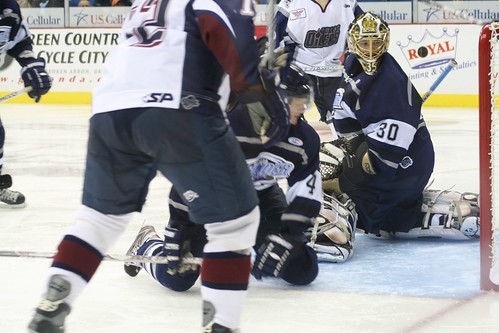
This photo was taken in the 3rd period in the area where the opposing team enters and leaves the ice. This area is just to the right of where I would normally be sitting in my season ticket area. I like it because the glass is not scuffed up as much and the bottom portion of the glass doesn't have an ad banner along the bottom 10 inches or so.
I plan to shoot from other areas in future games (there's another game tonight)(hopefully we'll win this time). Even with the media credentials, I feel a bit timid. I'm not one of those people who can just walk around as if I owned the place. Wearing the press pass still feels foreign to me. I feel more comfortable when I have my friend, who is a long-time writer for Pro Hockey News, is also standing there.
Oh, and I forgot to mention the other adjustments for me is that I don't get to sit down. I stand everywhere, except when I'm up in the press/media area. In addition, I already miss my friends, and I can tell them miss having me there too. I overheard one of them say "it's not the same without Les here." He continued, "There's no one to yell 'Stick lumber in his ear!!!'"
Wednesday, November 12, 2008
Not Quite a Greeny
I never have thought of myself as a greeny (but then again, I've never seen a complete definition of what a greeny is. Nonetheless, I find myself sympathizing more and more with the "green" side of various topics nowadays. Why is that?
First of all, I should state that I live in the country. My wife and I bought property in a rural area. We moved from the city. We moved to a rural area not to bring the city with us, but to leave it behind. All to often, we are frustrated with people who move nearby and then they talk to the town trustees about getting paved roads, and they want street lights. If they had their way, there'd be sidewalks out here. There'd be stop signs on every corner, cross walks, and lots of city ordinances telling us what we can and cannot do.
We notice people moving from the city that get out here and the first thing they want is to cut down trees. It's wooded in our area. Why would you move here if you don't want trees on your property? This is the woods. Why not buy property where there aren't trees?
Every time we've had any kind of work done on our property, it seems like people almost jump with glee at the chance to break out a chainsaw and cut down trees. Why is that?
I read today that NASA has published that the ratio between human beings on earth and trees, is approximately 1 in 66. So, there are 66 trees for every human being, but consider that there are lots of areas with lots of human beings, where the ratio isn't nearly that. The 1/66 ratio is for the entire earth.
Even at that, it is pointed out that 1/66 isn't enough of a ratio to be adequate for production of oxygen. I have to agree. Although I'm not a card carrying "greeny", at the same time, I have to stress the importance of trees in keeping human beings alive, and the fact that even more than climate change (which trees would play a part in preventing), we should be concerned about not having enough trees, and especially so knowing that so many are being cut down every day so that the land can be "developed".
All too often, hundreds of trees are downed at a time, and the developer plants baby trees after the development is complete, acting as if these few baby trees make up for what was lost. The trees that were gone might be 50 to 100 years old, and certainly produce more oxygen than the few baby trees planted afterwards. It can't be justified.
My wife and I are building on our property. We have cut down a few trees, but we've planted many more than we've downed. I think that in reality, we've only maybe killed one tree. We found a place that was relatively open and that's where we built our current house. We didn't pick a place and cut down trees. We found a clear spot and built there. It costed maybe one tree.
I'm not saying that my wife and I are better than anyone else, and I'm trying not to be arrogant about it, but I am saying that we practice what we preach. We have tried to avoid cutting down trees. We have built around what was here, but in anticipation of the need for more trees, we started planting in our pasture years ago. Some of those trees are now big enough to provide decent shade in the summer.
I would hope that as housing developments continue, that there'd be an effort to build around trees, rather than to doze the land and build, and then re-planting afterwards. That replanting takes decades to return to the production of oxygen that existed before the development. We can't keep cutting down trees and lowering the ratio as far as oxygen producing trees and human beings. We've got to start being a little more careful about how we develop, rather than just going for a quick fix to the problem of urban sprawl.
First of all, I should state that I live in the country. My wife and I bought property in a rural area. We moved from the city. We moved to a rural area not to bring the city with us, but to leave it behind. All to often, we are frustrated with people who move nearby and then they talk to the town trustees about getting paved roads, and they want street lights. If they had their way, there'd be sidewalks out here. There'd be stop signs on every corner, cross walks, and lots of city ordinances telling us what we can and cannot do.
We notice people moving from the city that get out here and the first thing they want is to cut down trees. It's wooded in our area. Why would you move here if you don't want trees on your property? This is the woods. Why not buy property where there aren't trees?
Every time we've had any kind of work done on our property, it seems like people almost jump with glee at the chance to break out a chainsaw and cut down trees. Why is that?
I read today that NASA has published that the ratio between human beings on earth and trees, is approximately 1 in 66. So, there are 66 trees for every human being, but consider that there are lots of areas with lots of human beings, where the ratio isn't nearly that. The 1/66 ratio is for the entire earth.
Even at that, it is pointed out that 1/66 isn't enough of a ratio to be adequate for production of oxygen. I have to agree. Although I'm not a card carrying "greeny", at the same time, I have to stress the importance of trees in keeping human beings alive, and the fact that even more than climate change (which trees would play a part in preventing), we should be concerned about not having enough trees, and especially so knowing that so many are being cut down every day so that the land can be "developed".
All too often, hundreds of trees are downed at a time, and the developer plants baby trees after the development is complete, acting as if these few baby trees make up for what was lost. The trees that were gone might be 50 to 100 years old, and certainly produce more oxygen than the few baby trees planted afterwards. It can't be justified.
My wife and I are building on our property. We have cut down a few trees, but we've planted many more than we've downed. I think that in reality, we've only maybe killed one tree. We found a place that was relatively open and that's where we built our current house. We didn't pick a place and cut down trees. We found a clear spot and built there. It costed maybe one tree.
I'm not saying that my wife and I are better than anyone else, and I'm trying not to be arrogant about it, but I am saying that we practice what we preach. We have tried to avoid cutting down trees. We have built around what was here, but in anticipation of the need for more trees, we started planting in our pasture years ago. Some of those trees are now big enough to provide decent shade in the summer.
I would hope that as housing developments continue, that there'd be an effort to build around trees, rather than to doze the land and build, and then re-planting afterwards. That replanting takes decades to return to the production of oxygen that existed before the development. We can't keep cutting down trees and lowering the ratio as far as oxygen producing trees and human beings. We've got to start being a little more careful about how we develop, rather than just going for a quick fix to the problem of urban sprawl.
Monday, November 3, 2008
Why Work So Hard?
I'm really beginning to question if I'm losing the will to work. During the time that I took off for a couple of months, we tightened our belt
and were able to live off my wife's salary with no perks. We were fine. I got a lot of progress on our house project. Now that
I'm working, little progress is being made on the house, and I'm looking at the political climate as far as prospects of being taxed
more for working hard. I'm starting to think that the stress of work is too much. Why work if the government is just
going to steal what little reward I get, so that they can give it to someone that doesn't work as hard as I do?
I had been thinking about taking a second job to get some extra money, but then that makes little sense if it's just going to allow
them to steal more from me. Why do it?
And as far as the investments I have, I'd rather pull it out of stocks and just keep it in money markets; which don't pay as much
but are more secure (relatively speaking). So what if not investing in stocks means fewer jobs. So what. If the
government doesn't care and the 30% out there that don't pay taxes don't care, then why should I care?
My new job is more stressful than the last. I'm being paid a little more, but I'm stressed a whole lot more. I'm
starting to feel like the stress is too much and the rewards aren't going to be worth it in an Obama economy.
I'll flat out tell you that I'm frustrated with the bailouts. This last bailout protected a number of US corporations from
stock shorting; but all that did was make those guys find new companies to short, like the companies I have a little bit of stock
in. So the bailouts took money out of my pocket to give to the execs that drove Wall Street into the ground, and so they
can continue to give bonuses (how are bonuses awarded in a company that virtually went bankrupt?). They took money from
me and made what I had left in my pocket less valuable. And now those companies are protected from stock shorting, but my
companies are not. Guess what, my companies, who looked promising before, now are virtually worthless.
So why work?
I don't believe Obama for a second when he says he'll only tax the rich (those that make more than $250,000 a year).
His website says $200,000. Which is it?
Joe Biden says $150,000. SO which one of those figures is it?
Bill Clinton told us the same thing when he was campaigning, and in the end, his protecting the middle class hit my wife and I
with the biggest tax increase I can remember. I have no reason to trust Obama. I have no reason to trust Biden.
I don't know if I can trust McCain, but at least he isn't promising a tax increase with a moving threshhold. Maybe he'd
raise my taxes too. I just don't trust Obama when he says that he wont. And the idea of working and sacrificing like
my wife and I have been doing these last few years, seems fruitless if it's just going to be stolen from us to give to people
that wont work and wont sacrifice.
And give me a break when you want to suggest that those folks out there are going to get 'their fair share' from the rest of us,
have been sacrificing. I don't know any that work two jobs. And I remember when my little company couldn't make
payroll and when we were issuing stock to employees instead of payment. I remember when we tried to give some of these
potential opportunities to people (poor people) and they wouldn't take them. They wanted cold hard cash, with no risk
on their part. I took the risk and sacrificed. And now that it's about to pay off, they want to share in the rewards.
Pardon the expression, but that's bullshit. That's not their fair share. That's Marxism and it's flat out wrong.
So under an Obama Administration, I do not intend to work hard. I do not intend to sacrifice or invest. I intend to
hold onto what little my wife and I have. If jobs suffer because of it, I think those 30% of the freeloaders that voted
so that they could get "their fair share' can just whallow in it. They got it and now they'll suffer the most, because it'll
be their jobs that will go first.
Subscribe to:
Posts (Atom)